
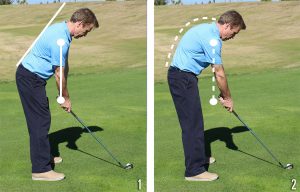
The basics of golf is grip and stance. If the golfer starts with shoulders closed to the target line then compensations must be made during the swing to square the clubface. The achievement of proper posture during address is a crucial aspect of these fundamentals.
Good posture varies from individual to individual. However, without good posture, your ability to complete effective weight shifts and trunk rotation is impaired. One of the most common technical faults is poor upper back posture. The more your upper back is flexed or curved, the more difficult it is to achieve complete torso or trunk rotation.
Combined Elevation Test
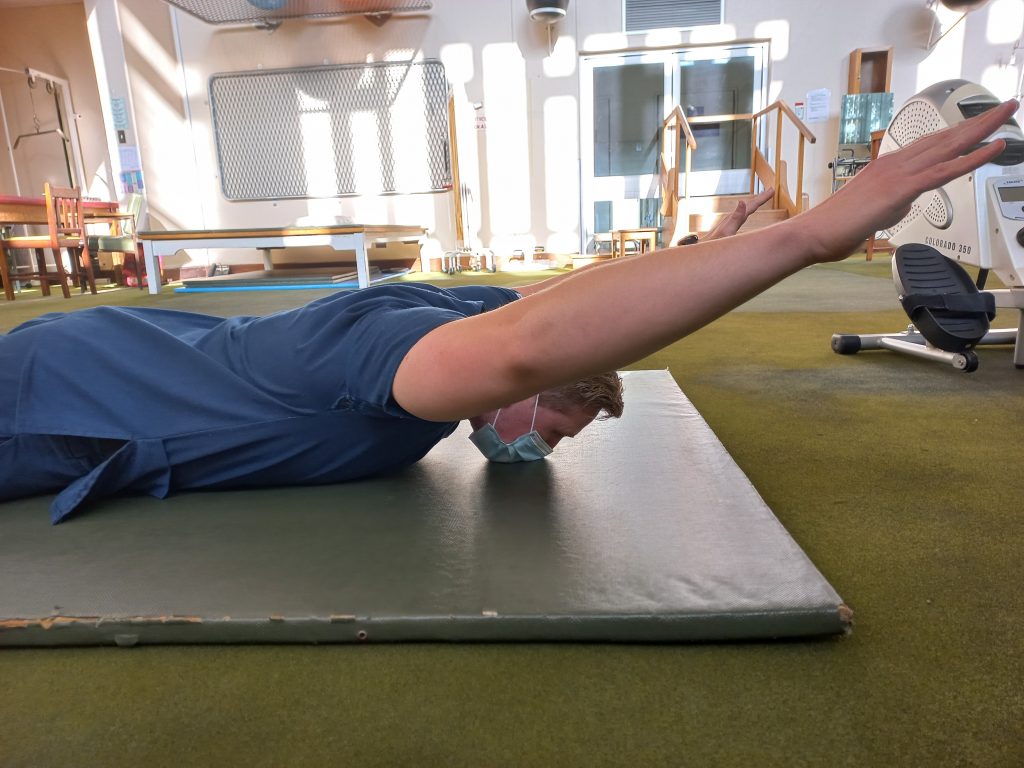
To measure how easily you can attain this posture and thus maximize the range of motion you have in the thoracic spine you can do the following test.
If you can lift your wrists less than 5cm off the ground (with straight elbows) then it is unlikely that you can easily attain the correct upper back posture. This means that you decrease the amount of torque or force producing torso rotation. If you can lift off around 10 to 15 cm you would be considered within ideal limits.
Step 1. Ley on your stomach, with your head looking up, you should be resting on your chin
Step 2. Extend your arms over head with your hands shoulder width apart and ensure that your elbows are straight. if you cannot do this you probably have problems with flexibility in your shoulders and your upper back.
Step 3. Now, measure how far you are able to lift your wrists, not your fingers, off the ground.
During takeaway, extension or backwards movement of your trunk occurs in combination with rotation. If you lose either of these movements then a number of compensations during the golf swing may result:
1. Lifting of your head
2. Lifting and thus separation of the arms from the trunk
3. Excessive flexing or bending of your left knee
If this is your common fault, then start by examining your basic setup and posture. Remember improved posture and range is about improved performance and technique as well as decreasing your risk of injury.
